
Note: This is the third part of a continuing series of stories taking a behind-the-scenes look at the ºìÐÓÖ±²¥app City University School of Music production of “Anastasia.â€�
BY ROD JONES
ºìÐÓÖ±²¥app COMMUNICATIONS
Scene design
For senior scenic designer Tess Rosen, bringing the world of “Anastasiaâ€� to the ºìÐÓÖ±²¥app City University stage combined building a set while solving a 27-scene puzzle.
As a designer whose background leans heavily toward theater, Rosen, a Design and Production major from Aurora, Colorado, noted that the sheer scope of a movie-musical like this production is a new frontier.
"Theater shows are usually one thing that lives on stage," she explained. "But in musicals, everything has to change. You have to get all these different locations squeezed into as little space as possible."
The result is a design that favors physical multipurpose set pieces over digital shortcuts.
Towers and portals
The core of the production’s visual identity lies in two "portals" and a series of rotating hexagonal towers. These are the waypoints of the story’s emotional journey, split amongst the differing scenes, for instance:
- Reality vs. the dream: One represents the grungy, street-stained reality of Bolshevik Russia, while the other serves as a gateway to the fantasy of Paris, a dreamland of golden Art Deco lines.
- Hexagonal towers: To handle the rapid-fire scene changes, Rosen designed towers that pivot to reveal different faces. One moment they might depict an abandoned theater, the next moment a cabin on a moving train.
Hold the projections
One of the most surprising choices the design team made was to reject the heavy use of video projections that characterized the Broadway production.
"We talked about how we really didn't want to do the thing that the Broadway musical does,� Rosen said. “We felt like it made it less magical somehow. It’s a little 'cheaty.' Projections should augment what you’re doing, not replace it."
To solve the pivotal train escape without a movie screen, the team turned to kinetic storytelling. Using moving lighting, the silhouette of a train cabin and luggage-laden actors, they collaborated to create the sensation of a moving locomotive.
Historical Easter eggs
Rosen, a self-described "history nerd," infused the set with layers of symbolism that many audience members might feel rather than see. The prologue is based on the Catherine Palace’s famous Amber Room (the Catherine Palace was the summer residence near St. Petersburg for Russian tsars). Rosen chose this as a metaphor for Anya’s story, as amber preserves things in time. But much like the Romanov legacy, the actual room was lost to history during World War II.
And audience members on the upper levels should watch out for Rosen’s Chagall floor. The texture of the stage floor is "ripped straight from a Marc Chagall painting," she said. Chagall was a Jewish-Russian artist who fled to Paris during the Revolution, mirroring Anya’s own journey.
Space is limited
Backstage, the challenge is space. With a massive ensemble wearing big, elaborate princess gowns and limited "fly" space (four cable line sets to hang things in the air), every inch of the stage had to be negotiated.
Rosen worked closely with the props team to scavenge the theatre storage unit on campus by the baseball fields, known as the Tinbug, to find historical furniture. Rather than buying new pieces, they reupholstered stock items to fit the show's color scheme, ensuring the furniture was both period-accurate and musical-proof to survive a high-energy dance number on top of it.
All good things must come to an end
Perhaps the most impressive part of the scenic operation is how it ends. Once the final curtain falls on Sunday, the set vanishes in a process called the strike.
"It’s very fun to watch," Rosen said. "It’s a little bit like watching termites just kind of take apart a house. The shop has it worked down to a science. In a couple of hours, it’s all dismantled, put away or thrown out."
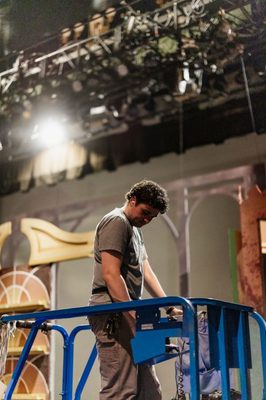
For Rosen, this production is a full-circle moment. Her first show at ºìÐÓÖ±²¥app was designed alongside the same lighting designer she is collaborating with for this, her final musical. It’s a fitting end to a journey that, much like Anya’s, is about finding home in the middle of a grand transformation.
Links to other stories in this series: intro, props & Costumes
Lighting Design
Lighting designer Peyton Rucker’s work on “Anastasia� is a mix of making sure the actors are visible while maintaining the prescribed sense of time, place and emotion. The lighting is a large part of what defines the borders between a revolution-torn Russia and a dreamlike Paris. And it all begins with a blank canvas.
"If we started painting a portrait of a face, I'm not starting at the first eyelash; I'm starting at the circle of a head," Rucker, a senior Design and Production major from Texas, said of his process.
For the audience in ºìÐÓÖ±²¥app’s Kirkpatrick Auditorium, that "circle" begins with a stark contrast in color temperature.
Tale of two temps
Rucker spent six months researching the time periods of the Russian Revolution and Roaring ’20s Paris through the eyes of the people who lived it. Specifically, the artists and historical figures. By looking at paintings and photos from the era, he determined how to distinguish the show’s distinct worlds:
- St. Petersburg: Defined by a cool, white, crisp cold, Rucker’s replication of snow led him to avoid heavy shadows, mimicking the way sunlight reflects off a frozen landscape to create an "overlooming sense of dread" that feels contained and desolate.
- Paris: The palette shifts to warm tones, representing a big relief for the characters. It’s bright, open and flashy.
- The Disney layer: On top of the historical realism, Rucker layers saturated purples, reds and blues. "It’s a musical, a world of mystery and wonder," he explained. "Those colors help us get into the musicality of it."
The 'Swan Lake' shift
One of the most unique challenges of “Anastasia� is the show within a show, the “Swan Lake� ballet sequence. Lighting a musical is usually more about faces, but lighting a ballet is about the physique.
Rucker utilized low-boom sidelights for these sequences. By placing lights on the floor rather than only from up high, he can carve the dancers' movements out of the air, highlighting their form and motion.
"I’m not lighting it just to look cool," Rucker said. "I’m lighting it to support the story. We have to convey to the audience that they are actually sitting at a ballet."
No projection, please
While the Broadway production of Anastasia used massive LED screens to simulate the famous train escape, the ºìÐÓÖ±²¥app team took a more magical (and manual) approach.
To create the sensation of a train moving through the night without the shortcut of a projection screen, Rucker uses:
- Kinetic lighting: Lights programmed to flicker and move, simulating trees passing by on a track.
- Hazers: Dense theatrical haze catches the beams of light, creating the "steam" of a locomotive and the passage of light.
- Shadows: By using "low fronts" to color the shadows (shadows, he points out, are rarely just black — they’re often deep blues or greens), he creates a sense of depth and motion that feels physical rather than digital.
Schedule hustle
Rucker is managing the design for this massive show while balancing a more-than-full-time 21-credit hour class schedule. Despite the late nights in the Kirkpatrick, he credits the spirit of fellowship within the lighting department, led by professor Annalise Caudle, for keeping the team grounded.
"People ask if you’d want an extra day of rehearsals or another week of tech," Rucker said. "Lighting people? We want more tech. That’s where the magic actually happens."
One less thing to worry about this year is sourcing and installing some of the more modern gear in professional theater, thanks to funding from a grant last year. Much of what he’s using for this show would have otherwise been rented from elsewhere.
“It gave us some new lighting instruments, which allowed me to rent less lights, which allowed us to pay for some upgraded equipment, which will allow us to elevate the show even more,� Rucker said.
See more photos of scene designing in the works .
